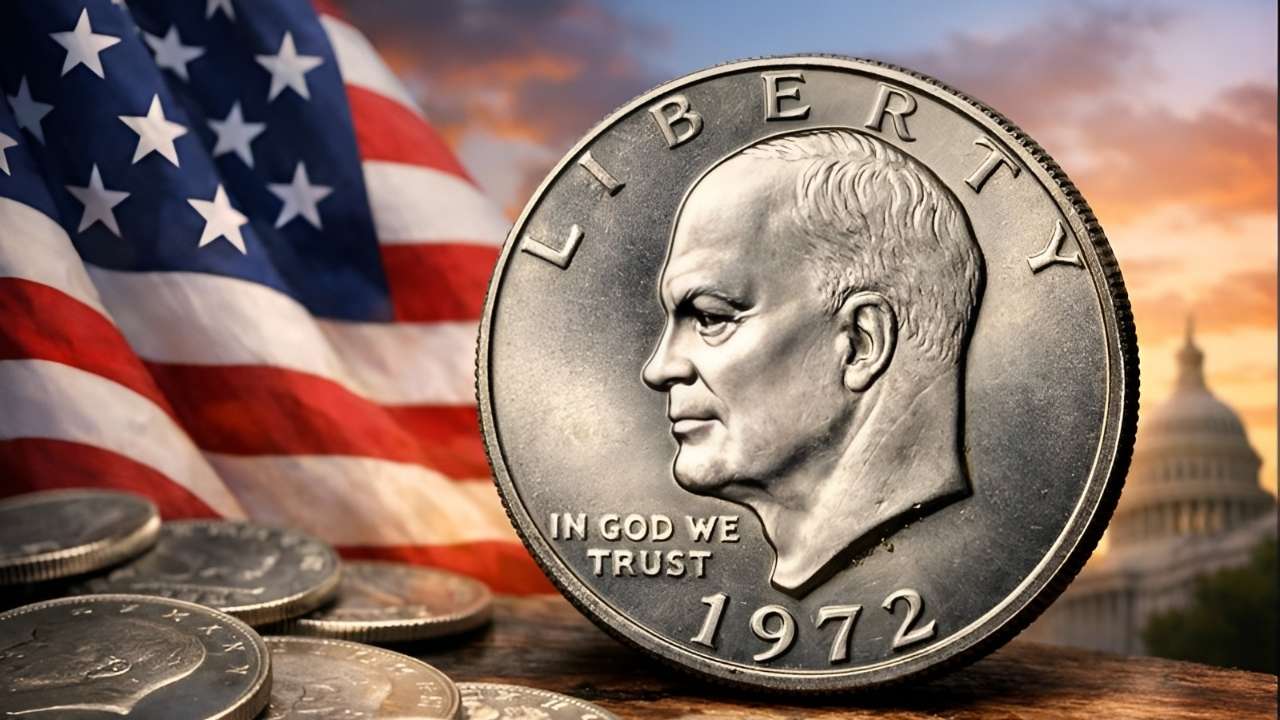
1972 Eisenhower Dollar Coin: The Eisenhower Dollar was first introduced in 1971 to honor President Dwight D. Eisenhower and to commemorate the Apollo 11 moon landing. Large and striking in design, the coin quickly became a collector’s item despite its short run in circulation. Among the Eisenhower Dollars, the 1972 issue stands out because of its unique varieties and minting quirks. These coins, while often overlooked, can be worth a fortune if you know what to look for. Collectors prize them for their rarity, historical significance, and the fascinating differences in design that emerged during production.
The Background of the 1972 Eisenhower Dollar
The United States Mint faced challenges when producing the Eisenhower Dollar. The coin was larger than most circulating pieces, and striking it on copper-nickel clad planchets proved difficult. As a result, several reverse designs were created to improve the quality of the strike. This led to three distinct varieties of the 1972 Eisenhower Dollar, each with its own characteristics and rarity. These varieties are known as Type 1, Type 2, and Type 3, and they form the foundation of the coin’s collectible value.
Type 1 Reverse
The Type 1 reverse was the first design used in 1972. It was prepared in low relief, which made it easier to strike but less detailed in appearance. The Earth behind the eagle on the reverse design appears flat and indistinct. While common compared to the other varieties, Type 1 coins are still collectible, especially in high grades. Circulated examples are worth only a few dollars, but uncirculated coins can reach hundreds, and pristine specimens may climb into the thousands.
Type 2 Reverse
The Type 2 reverse is the rarest and most valuable of the 1972 Eisenhower Dollar varieties. This design features a high relief Earth with clearer details, including islands that are more accurately depicted. The Type 2 reverse was used primarily on 40 percent silver proof coins, but a small number of copper-nickel clad coins from the Philadelphia Mint also received this design. Because of its scarcity, the Type 2 Eisenhower Dollar can be worth a fortune. In top condition, examples have sold for more than fourteen thousand dollars at auction, making it one of the most sought-after coins in the series.
Type 3 Reverse
The Type 3 reverse was introduced later in 1972 after the Mint improved its die steel. This allowed for a higher relief design that was more resilient and detailed. The Earth on the reverse is more rounded and shows clearer features than the Type 1. Type 3 coins are more common than Type 2 but less so than Type 1. Collectors value them for their improved design and historical significance. High-grade examples can be worth thousands, especially when certified by professional grading services.
Mint Marks and Their Impact
The 1972 Eisenhower Dollar was struck at multiple mints, including Philadelphia, Denver, and San Francisco. Coins from Philadelphia carry no mint mark, while Denver coins are marked with a D and San Francisco coins with an S. The mint mark can significantly affect the value, especially when combined with the reverse type. For example, a Philadelphia Type 2 coin is far rarer than a Denver Type 1, and collectors pay accordingly. Proof coins from San Francisco, particularly those struck in silver, are also highly prized.
Errors and Varieties
Beyond the three main reverse types, error coins from 1972 add another layer of intrigue. Misstrikes, off-center coins, and double dies can all increase value dramatically. Collectors love these anomalies because they represent unique pieces of minting history. While not as common as the reverse varieties, error coins can fetch thousands depending on rarity and condition.
Grading and Condition
As with all coins, the condition of a 1972 Eisenhower Dollar plays a crucial role in determining its value. Coins are graded on a scale from Poor to Mint State, with higher grades commanding higher prices. A Type 2 Eisenhower Dollar in Mint State 66, for example, has sold for more than fourteen thousand dollars. Even Type 1 and Type 3 coins can reach impressive values when preserved in pristine condition. Collectors should always consider professional grading to maximize the potential of their coins.

Collecting Strategies
For collectors, the 1972 Eisenhower Dollar offers a fascinating challenge. Completing a set of all three reverse types is a rewarding goal, and finding a Type 2 in high grade is a true achievement. Collectors often focus on mint marks, varieties, and condition when building their collections. Proof coins from San Francisco are popular, while Philadelphia Type 2 coins remain the ultimate prize. Patience and careful searching are key, as these coins can appear in unexpected places, from old collections to estate sales.
Historical Significance
The Eisenhower Dollar is more than just a collectible coin. It represents a period of American history marked by space exploration and the legacy of a respected president. The reverse design, featuring the eagle landing on the moon, ties directly to the Apollo 11 mission and symbolizes human achievement. Owning a 1972 Eisenhower Dollar is not just about monetary value but also about holding a piece of history that connects to both national pride and numismatic artistry.
Conclusion
The 1972 Eisenhower Dollar is a coin that continues to captivate collectors with its varieties, errors, and historical significance. From the common Type 1 to the rare and valuable Type 2, these coins offer opportunities for discovery and investment. High-grade examples can be worth a fortune, with some selling for more than ten thousand dollars. Whether you are a seasoned collector or a curious beginner, the 1972 Eisenhower Dollar is a reminder that treasures can be found in the most unexpected places. By understanding its varieties and appreciating its history, you can unlock the true potential of this remarkable coin.